

Addressing delegates at the International Conference on Family Planning #ICFP2025, the Government of Zimbabwe committed USD 2.25 million annually towards the procurement of contraceptives in 2026 and 2027. This is in addition to the USD 6.3 million worth of contraceptives that have been procured from domestic resources since 2023 through the Compact Agreement and Match Fund arrangement with UNFPA Zimbabwe.
Speaking at the International Conference, Honourable Minister of Health and Child Care Dr Douglas Mombeshora reiterated the significance and importance of innovative partnerships such as the UNFPA Supplies Compact and Match Fund have helped accelerate the shift towards domestic financing.
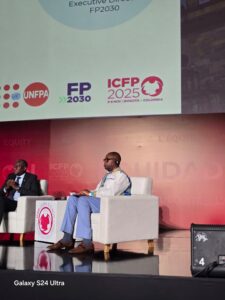
Honourable Minister of Health and Child Care, Dr Douglas Mombeshora (white shirt) attending the ICFP2025 conference
Dr Douglas Mombeshora said: “The government has invested over USD 6.3 million in the past three years to procure contraceptives using domestic resources. To complement these efforts, Zimbabwe became one of the first countries in the East and Southern Africa Region to qualify for Match Funding through the United Nations Population Fund Global Supplies Partnership. This is a testament to our belief that family planning is not a luxury, but it is a right, and it is a cornerstone of national development.” The government commitment is to ensure every woman and girl in Zimbabwe has access to quality reproductive health services.

Zimbabwe Minister of Health and Child Care Hon. Dr. Douglas Mombeshora and UNFPA Executive Director Ms Diene Keita at the ICPF 2025
UNFPA match funding is a component of the UNFPA Supplies Partnership that incentivizes governments to increase domestic spending on quality-assured reproductive health commodities by matching their contributions. For every dollar a government invests, UNFPA provides two dollars’ worth of these essential supplies. This financing mechanism helps governments secure needed contraceptives and medicines, promoting stronger national health systems and greater investment in family planning. A powerful step towards self-reliance, sustainability, and choice.